
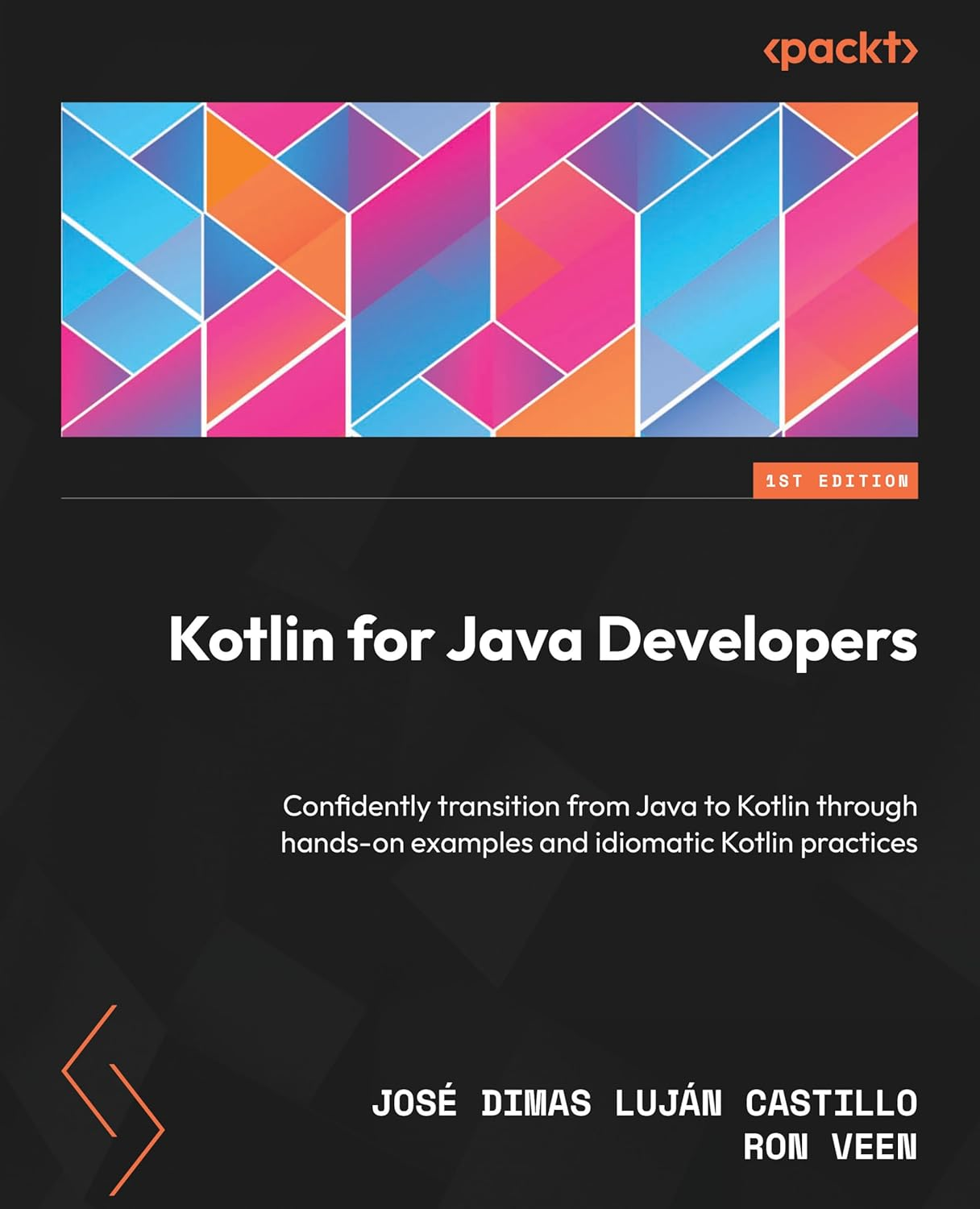
Jose Dimas Luján Castillo/Ron Veen
Truly, the Kotlin language is not very new at the time I’m writing this; the first stable version of Kotlin was officially launched in 2016. However, that does not mean we know everything about the language; on the contrary, this book is a good opportunity to learn about the Kotlin basics and its interoperability with Java and the integration with the JVM.
About authors
Jose Dimas Luján is an experienced developer, writer, professor, and has other skills. By today, he has written 9 books, primarily for mobile development such as Android, Flutter, along with Java, HTML, CSS, JS, and Python. From my personal experience, I like Jose’s writing style. I have had the opportunity to read four of their books, and I can say you won’t have any problem following the writing, with clear examples and analogies.
Ron Veen is also a very skilled developer with over 15 years of experience working with the JVM and Java ecosystem.
About the book
Are you an experienced Java developer with many years in the industry? A student who learned programming at university using Java and now wants to learn Kotlin? Or maybe an Android developer still working mainly with Java who wants to stay aligned with Google’s recommendation to adopt Kotlin as the primary language? Or perhaps you simply want to strengthen your Kotlin knowledge.
You know what? It doesn’t really matter what your starting point is. What truly matters is that by reading this book, you can go from zero to an expert in Kotlin.
The authors navigate through a wide range of Kotlin topics, including programming paradigms, Kotlin/JS, Kotlin/WASM, the relationship between Kotlin and the JVM, and Kotlin DSLs, as well as Gradle and Maven—just to mention a few.
If you’re interested in threading, synchronization, and asynchronous tasks, this book also covers the fundamentals of Coroutines. Coroutines are the way Kotlin handles asynchronous work in a clean, efficient, and well-integrated manner. This is a must-have skill for any Kotlin or Android engineer in daily work, and I really appreciate that the book dedicates space to this topic.
Regarding DSLs, the book gives you a solid overview of what they are and how to start working with them. As an Android engineer, this is extremely useful, since Kotlin DSL makes Gradle configurations easier to read, understand, and maintain—all using a single language. This is a big improvement compared to the old days of using Groovy for Gradle or XML when working with Maven.
There are many more Kotlin topics covered in this book, such as nullability handling and data classes, but I don’t want to spoil your reading experience. I’m confident you’ll enjoy this book, and it’s definitely a great step toward going deeper into the Kotlin world.
Useful Links
Where to get the book: https://www.packtpub.com/en-us/product/kotlin-for-java-developers-9781835884836 (eBook/Paperback)
Also if you like to read about book reviews, I will be writing about them here: https://blog.alangaelrojas.com/index.php/book-reviews/


Leave a Reply